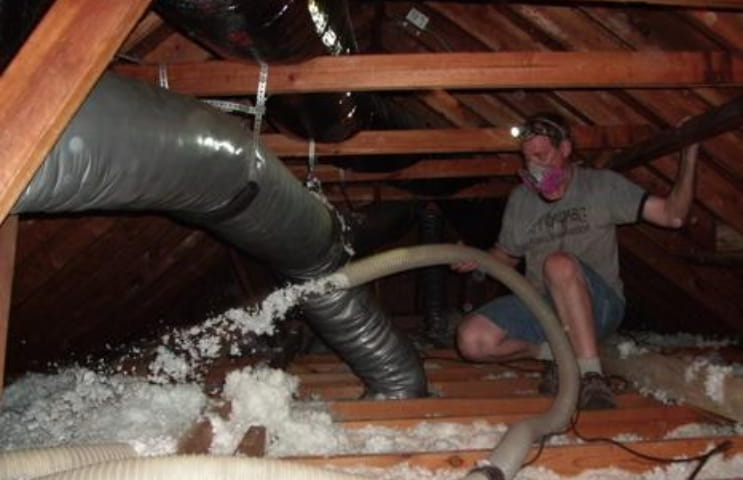
Blown-In Attic Insulation in Houston & Katy, TX
Houston summers are relentless. From May through October, attic temperatures routinely climb above 140 degrees Fahrenheit, and that heat pushes straight down into your living space, forcing your air conditioner to run longer, work harder, and cost you more every single month.
Blown in fiberglass insulation is the most effective way to stop that heat transfer at the source. It creates a continuous thermal layer across your entire attic floor, filling every gap, corner, and irregular space that other insulation types leave exposed. The result is a cooler home, lower energy bills, and an HVAC system that is no longer fighting a losing battle against a superheated attic.
At Affordable Attic Insulation, Jason personally handles every blown fiberglass insulation Houston installation from start to finish. No subcontractors, no crew turnover, no shortcuts. After more than 20 years insulating homes across the Houston and Katy area, he brings the kind of attention to detail that only comes from doing this work yourself, every single day.
Call (346) 205-1864 for a free attic inspection and quote.
What Blown-In Fiberglass Insulation Is and How It Works
Blown in fiberglass insulation is a loose fill product made from fine glass fibers. Unlike batt insulation, which comes in pre-cut rolls or sheets that must be fitted around obstacles, loose fill fiberglass is a free-flowing material that conforms to the exact shape of your attic.
Installation uses a commercial blowing machine. A flexible hose feeds the material from the machine into your attic, where it is distributed in controlled passes across the attic floor. The fiberglass fills in around joists, HVAC equipment, pipes, and any other obstructions without gaps or seams. Where batt insulation leaves thermal weak spots at every irregularity, blown in fiberglass insulation covers everything.
This matters in older Houston homes especially. Attics built before the 1990s often have non-standard joist spacing, inconsistent framing, and decades of accumulated pipes and wiring running through the floor. Blown-in fiberglass handles all of it. The material simply flows into every available space and builds up to the required depth.
The process typically takes two to four hours for an average Houston area attic. When Jason leaves, your attic has a clean, uniform layer of insulation measured against target depth markers to confirm the correct R-value has been achieved.
Benefits of Blown In Attic Insulation
Thermal Performance That Holds Up in Texas Heat
The primary job of attic insulation is thermal resistance, and blown in fiberglass insulation does that job exceptionally well in Houston's Climate Zone 2 conditions. A properly installed layer at the right depth keeps attic heat from radiating down into your ceiling and living space, which means your air conditioner maintains your target temperature without constantly cycling on.
Homeowners who upgrade from the thin, degraded insulation common in pre-2000 Houston homes typically notice the difference within the first billing cycle. Rooms that were consistently too warm, especially upstairs bedrooms and spaces directly under the roof, stabilize at more comfortable temperatures. The AC runs less. The house feels more consistent.
Sound Dampening
A well-insulated attic is a quieter attic. The fiberglass layer absorbs sound transmission from outside, which reduces the noise of rain on the roof, traffic, and wind. For homes near busy roads or flight paths in the Houston metro area, this is a meaningful secondary benefit.
Fire Resistance
Blown in fiberglass insulation is non-combustible. It is made from glass, an inorganic material that does not ignite and does not contribute fuel to a fire. No chemical fire retardant treatments are required to achieve this property. The material is inherently fire safe in a way that paper-based alternatives simply are not.
Moisture and Rot Resistance
Glass does not absorb water, rot, or support mold growth. If your attic experiences a roof leak or elevated humidity, blown in fiberglass insulation will get wet and dry out without structural damage to the material itself. It does not harbor the kind of organic matter that mold needs to establish. For Houston homeowners dealing with Gulf Coast humidity year-round, this is a real advantage over alternatives.
Why We Use Blown-In Fiberglass and Not Cellulose
Both blown in fiberglass and cellulose are loose fill insulation products installed with a blower. On the surface they appear similar. In practice, for Houston area attics, they behave very differently.
R-value retention over time. Blown in fiberglass settles approximately 3 to 5 percent over its lifetime. Cellulose, which is made from shredded recycled paper, settles 15 to 20 percent. A cellulose installation that starts at R-38 can drop to R-30 or below within a few years as the material compacts under its own weight. Fiberglass holds its rated R-value far more consistently, meaning the investment you make today performs as expected ten, twenty, and thirty years from now.
Moisture behavior in a humid climate. Cellulose is hygroscopic, meaning it absorbs and holds moisture from the air. In Houston's climate, where humidity is a constant factor, this is a significant liability. Wet cellulose loses R-value, compresses faster, and creates conditions that invite mold. Blown in fiberglass does not absorb moisture and returns to full performance after drying.
Cost per square foot. Blown in fiberglass is typically less expensive to install than cellulose at equivalent R-value targets, particularly when accounting for the additional depth cellulose requires to compensate for settling.
Longevity. Blown in fiberglass insulation lasts 40 to 80 years or more. Cellulose typically requires replacement or major top-up service within 20 to 30 years. For most Houston homeowners, fiberglass delivers more R-value per dollar over the full life of the home.
R-Value, Depth, and What Houston Homes Actually Need
R-value measures how effectively insulation resists heat flow. The higher the number, the better the thermal barrier. For blown in fiberglass insulation, the R-value is approximately R-2.5 per inch of depth.
Houston and the surrounding area fall within IECC Climate Zone 2. The Department of Energy recommends R-30 to R-60 for attic insulation in this zone. Texas building code targets a minimum of R-38 for new construction. Most Houston homes built before 2000 fall well short of this, many sitting at R-11 to R-19 from their original installation.
| Target R-Value | Depth Required | Best For |
|---|---|---|
| R-30 | ~10 inches | Minimum DOE recommendation for Climate Zone 2 |
| R-38 | ~13 inches | Texas building code minimum, recommended for most Houston homes |
| R-49 | ~17 inches | Two-story homes, rooms directly under the roof |
| R-60 | ~20 inches | Maximum energy performance, highest bill reduction |
For most Houston and Katy area homes, R-38 is the practical target that balances performance and cost. Homes with two stories, where upstairs bedrooms are directly under the roof, often benefit from going to R-49 or higher because the heat load on those rooms is significantly greater.
Costs, Energy Savings, and Payback
The cost of a blown fiberglass insulation Houston installation depends on several factors: the size of the attic, how much existing insulation is in place, whether air sealing work is needed, the target R-value, and the ease of attic access.
For a typical Houston area home between 1,500 and 2,500 square feet, most homeowners invest between $1,500 and $3,500 for a complete blown in fiberglass insulation project including air sealing. Larger homes, attics requiring removal of old insulation, or projects targeting R-49 and above will fall toward the higher end of that range.
Upgrading attic insulation in a Houston home from below R-20 to R-38 or higher typically reduces heating and cooling costs by 15 to 30 percent annually. For a home spending $250 per month on energy, that is $450 to $900 in annual savings. At that rate, most blown in fiberglass insulation projects pay for themselves within three to six years, after which the savings continue for the remaining decades of the insulation's lifespan.
Common Problems and How They Are Addressed
Uneven Coverage and Low Depth Zones
Attics with complex framing, multiple HVAC runs, or heavy storage use can develop low spots where insulation has been compressed or displaced. These areas act as thermal weak points regardless of the overall R-value achieved elsewhere. Jason checks for these during and after installation. Low depth zones are addressed with additional material before the job is completed.
For existing homes where blown in fiberglass insulation was installed years ago and has settled or been disturbed, the solution is usually a targeted top-up, adding new material over the existing layer to restore the correct depth. This is more cost effective than full removal in most cases, provided the existing insulation is clean and dry.
Wet Insulation
Water intrusion from a roof leak is the most serious threat to blown in fiberglass insulation. If insulation gets wet, it must be inspected carefully. Fiberglass itself dries out and can often be left in place once the water source is repaired, provided there is no mold growth on the materials below it. If moisture has persisted long enough to cause mold on the attic sheathing or framing, remediation is required before any insulation work proceeds. If you have had a roof leak and are unsure of the condition of your attic insulation, a free inspection will give you a clear answer.
Our Attic Insulation Services
Spray-On
Radiant Barrier
A spray-on radiant barrier reduces attic temperatures by reflecting radiant heat away from your roof deck, lowering the load on your HVAC system and your energy bills.
Learn More
Attic
Staircase Cover
An attic stair cover creates a sealed thermal barrier between your living space and your attic, preventing conditioned air from escaping through the access point.
Learn More
Our
Locations
Serving Houston, Katy, Sugar Land, Cypress, Pearland, Spring, and throughout the Greater Houston metro area.
Learn More
Blown-In Fiberglass Insulation FAQs
How long does blown-in fiberglass insulation last?
Can new blown-in fiberglass be installed over old insulation?
How do I know if my attic needs more insulation?
How much insulation does a Houston home need?
Will new insulation lower my energy bills?
Does blown-in fiberglass insulation help with sound?
Is blown-in fiberglass insulation a fire hazard?
Does Insulation Help Cut Energy Bills?
How Does Blown-In Insulation Work?
How Much Insulation Does My Home Need?
Schedule Your Free Attic Inspection
If your Houston or Katy home is more than 15 years old and you have not had the attic insulation evaluated recently, there is a good chance you are spending more on energy every month than you need to.
A free inspection with Jason takes about 20 minutes. He will check your current insulation depth and condition, identify any air sealing issues, and give you a straight answer about what your attic needs and what it will cost.
No high-pressure sales. No subcontractors. Just honest advice from someone who has been doing this work in Houston for over 20 years.
Call (346) 205-1864 or request a quote online to schedule your free attic inspection today.
Serving Houston, Katy, Sugar Land, Missouri City, Cinco Ranch, Brookshire, Friendswood, Clear Lake, Pearland, Tomball, Richmond, Fulshear, Cypress, Spring, and Bellaire.