Radiant Barrier Insulation in Houston & Katy, TX
Your roof absorbs heat from the sun all day. By mid-afternoon on a Houston summer day, the underside of your roof deck is radiating heat downward at temperatures that can exceed 160 degrees Fahrenheit. That radiant heat pours through your attic, heats up everything below it including your ductwork and ceiling, and forces your air conditioner to fight a constant, expensive battle it was never designed to win on its own.
A spray-on radiant barrier changes that equation. Applied directly to the underside of your roof deck inside the attic, it creates a reflective aluminum coating that turns away radiant heat before it has a chance to enter your attic space. The result is a measurably cooler attic, lower strain on your HVAC system, and real reductions in your monthly energy bills.
At Affordable Attic Insulation, Jason personally handles every radiant barrier spray installation in the Houston and Katy area. No subcontractors, no crews you have never met. After more than 20 years working in Houston area attics, he knows exactly how the combination of Gulf Coast humidity, intense summer heat, and the typical construction of homes in this region affects attic performance, and how to address it.
Call (346) 205-1864 for a free attic inspection and quote.
What Radiant Heat Is and Why It Matters in Houston
To understand what a radiant barrier does, it helps to understand how heat actually moves into your home.
Heat travels in three ways: conduction, convection, and radiation. Your attic insulation addresses conduction, the slow transfer of heat through solid materials. Radiant heat is different. It travels as infrared energy across open space, the same way the sun warms your skin even on a cold day. It does not need to touch a material to heat it. It simply radiates from a hot surface and is absorbed by whatever it reaches.
In your attic, the source of that radiant heat is your roof deck. The sun heats the shingles, the shingles heat the plywood beneath them, and that plywood radiates infrared energy downward into the attic. The attic air heats up. Your ceiling heats up. Your ducts heat up. Your insulation absorbs heat from above even as it tries to slow heat from below. Your air conditioner runs longer to compensate.
A spray-on radiant barrier applied to the underside of that roof deck interrupts this process at the source. Instead of the plywood absorbing and radiating heat freely into the attic, the reflective aluminum coating bounces much of that infrared energy back upward before it can enter your living environment.
This is not a replacement for attic insulation. It is a complement to it. Insulation slows conductive heat transfer through your ceiling. A radiant barrier reduces the radiant heat load the insulation has to work against in the first place. Together, they address the full picture of how heat enters a Houston home.
How Spray-On Radiant Barrier Works
The product Jason applies is a water-based aluminum reflective coating, commercially formulated for attic application as an Interior Radiation Control Coating System. It is not standard paint. The aluminum content in the coating is what creates the reflective property. Once it dries on the roof deck surface, it forms a metallic layer that reflects radiant infrared energy rather than absorbing it.
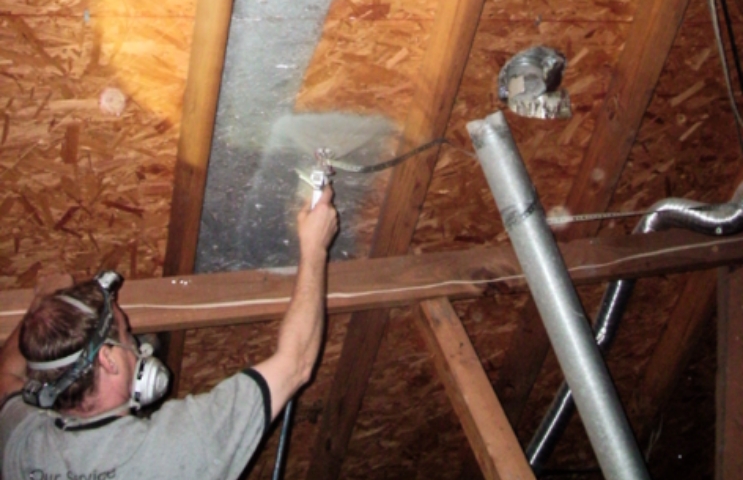
The coating is applied directly to the underside of the roof sheathing from inside the attic using a professional airless spray system. This reaches into the angles and edges around rafters and trusses that would be difficult or impossible to access with foil material, ensuring full coverage across the entire roof surface. That makes it especially practical in existing homes where traditional foil products are harder to install cleanly.
A quality spray-on radiant barrier installation from a professional contractor using the right commercial-grade product can reflect 70 to 81 percent of radiant energy back toward the roof, translating directly into lower attic temperatures and reduced heat load on everything below.
Spray-On Radiant Barrier vs. Foil Radiant Barrier
This is the question most Houston homeowners ask before booking an installation, and it deserves a straight answer.
The honest reason to choose spray-on comes down to attic conditions and installation quality in the real world.
Coverage in complex attics. Most Houston area homes were built with attic framing that includes cross bracing, HVAC equipment, ductwork, and irregular rafter patterns. Installing foil in these attics requires cutting around every obstruction, stapling into angles and corners that are difficult to reach, and managing seams and gaps across a complicated surface. In a typical retrofit attic, complete foil coverage is rarely achieved in practice. Spray-on reaches every surface the hose can access, including the angles alongside every rafter and the edges where foil inevitably leaves gaps.
No air gap dependency. Foil radiant barriers require an air gap between the reflective surface and the roof deck to function correctly. If foil lies against the deck surface, it conducts heat rather than reflecting it. Spray-on is applied directly to the deck surface and works through its low-emissivity properties rather than requiring an air gap to function.
Speed and disruption. A spray-on application on a typical Houston home takes a few hours. A full foil installation in a complex attic can take significantly longer, with more opportunity for incomplete coverage.
The real-world comparison. A well-executed spray-on installation covering 100 percent of the roof deck surface outperforms a foil installation with gaps, missed corners, and incomplete rafter coverage in practice. For the vast majority of Houston and Katy homes with typical attic conditions, a professional spray-on application is the more practical, more reliable choice.
What Spray-On Radiant Barrier Does for Your Home
Reduces Attic Temperatures
A professional spray-on radiant barrier installation typically reduces attic temperatures by 20 to 30 degrees Fahrenheit during peak summer heat. In a Houston attic that would otherwise reach 155 degrees on a July afternoon, that brings temperatures down to the 125 to 135 degree range. That reduction changes the environment your ductwork, ceiling, and insulation are operating in for the entire cooling season.
Lowers Cooling Costs
When your attic runs cooler, your air conditioner does not have to work as hard to maintain comfortable temperatures in the rooms below. Houston homeowners who add a spray on radiant barrier typically see 10 to 15 percent reductions in cooling costs. For a home spending $300 per month on electricity in summer, that is $30 to $45 in monthly savings during the months when your energy bills are at their peak.
Extends HVAC System Life
The most overlooked benefit of radiant barrier installation is what it does for your HVAC equipment. Air conditioning units that run in shorter, less frequent cycles wear significantly more slowly than units that run continuously against an elevated heat load. Reducing attic temperatures reduces the workload on your system, which extends compressor life and reduces the frequency of service calls and repairs.
This benefit is amplified for homes where ductwork runs through the attic. Hot attic air surrounding unconditioned ducts causes significant heat gain in the conditioned air before it ever reaches your rooms. A cooler attic means the air your ducts are carrying stays closer to its intended temperature.
Protects Your Roof
Extreme heat cycling is one of the primary causes of premature shingle and roof deck degradation. When the roof deck is repeatedly heated to extreme temperatures and then cooled, the wood and adhesives in the structure expand and contract. A radiant barrier that reduces the temperature differential in the deck extends the life of your roofing materials alongside everything else.
Works Year Round
During Houston winters, the reflective coating works in the opposite direction. Heat inside your home radiates upward toward the roof. The coating reflects some of that heat back down toward the living space rather than allowing it to escape through the roof deck. The effect is less dramatic than the summer cooling benefit, but it contributes to reduced heating costs during the cooler months.
The Installation Process
Before any coating is applied, Jason inspects the attic. He checks the condition of the roof deck, looks for any moisture damage or areas of concern, confirms that attic ventilation is functioning correctly, and identifies any areas that need special attention.
The coating is applied using a professional airless spray system. Jason works in systematic passes across the full underside of the roof deck, covering the sheathing between and alongside every rafter and truss. The goal is complete, even coverage with no gaps or missed sections, because gaps in a radiant barrier are where heat finds its way through.
The coating dries quickly and does not require any curing period before the attic returns to normal use. The entire installation on a typical Houston area home takes two to four hours. Your living space is undisturbed throughout the process.
Once the coating is applied, there is no ongoing maintenance required. The aluminum reflective layer does not degrade under normal attic conditions and does not require reapplication.
Pairing Radiant Barrier with Blown-In Fiberglass Insulation
A radiant barrier and blown-in fiberglass insulation address two different mechanisms of heat transfer, and they work best together.
The radiant barrier reduces the amount of radiant heat entering the attic from the roof deck above. Blown-in fiberglass insulation slows the conductive transfer of heat through the ceiling below. When both are in place, the attic environment is cooler, the thermal load on the insulation is lower, and the insulation performs more effectively because it is not working against a superheated attic above it.
For Houston homeowners dealing with high energy bills, uncomfortable upstairs rooms, or an HVAC system that runs constantly in summer, combining a spray-on radiant barrier with a blown-in fiberglass upgrade to R-38 or higher is the most complete attic performance solution available at this price point.
Many homeowners choose to have both installed during the same visit. Jason can inspect your attic, assess both the roof deck and the insulation level, and quote both services at once. Learn more about blown-in fiberglass insulation.
Costs and Payback
The cost of a spray-on radiant barrier installation depends on the size of your attic and its complexity. For a typical Houston area home between 1,500 and 2,500 square feet, most homeowners invest between $800 and $2,000 for a professional spray-on radiant barrier application.
At 10 to 15 percent annual cooling cost savings, most installations pay for themselves within three to five years. After that point, the savings continue for the remaining life of the coating with no additional investment required.
The payback period shortens for homes with higher summer energy bills, older HVAC systems working harder against a heat load, and homes where ductwork runs through the attic and is currently surrounded by extreme heat.
Our Attic Insulation Services
Blown-In
Fiberglass Insulation
Creates a continuous thermal layer across your entire attic floor, filling every gap and irregular space for maximum energy efficiency and lasting R-value performance.
Learn More
Attic
Staircase Cover
An attic stair cover creates a sealed thermal barrier between your living space and your attic, preventing conditioned air from escaping through the access point.
Learn More
Our
Locations
Serving Houston, Katy, Sugar Land, Cypress, Pearland, Spring, and throughout the Greater Houston metro area.
Learn More
Spray-On Radiant Barrier FAQs
Does a radiant barrier replace attic insulation?
How long does spray-on radiant barrier last?
Will it make my attic too hot in winter?
Does my attic need to be a certain type for this to work?
Can it be installed on top of existing insulation?
How much will I actually save on my energy bills?
Is the installation disruptive to my home?
Is spray-on radiant barrier safe?
Schedule Your Free Attic Inspection
If your Houston or Katy home does not have a radiant barrier and your energy bills climb every summer, your attic is likely running at temperatures that your insulation and HVAC system were not designed to handle alone.
A free inspection with Jason takes about 20 minutes. He will check your roof deck condition, assess your current insulation level, and give you an honest recommendation on whether a spray-on radiant barrier installation makes sense for your home and what it will cost.
No pressure. No subcontractors. Just a straight answer from someone who has been working in Houston area attics for over 20 years.
Call (346) 205-1864 or request a quote online to schedule your free attic inspection today.
Serving Houston, Katy, Sugar Land, Missouri City, Cinco Ranch, Brookshire, Friendswood, Clear Lake, Pearland, Tomball, Richmond, Fulshear, Cypress, Spring, and Bellaire.